

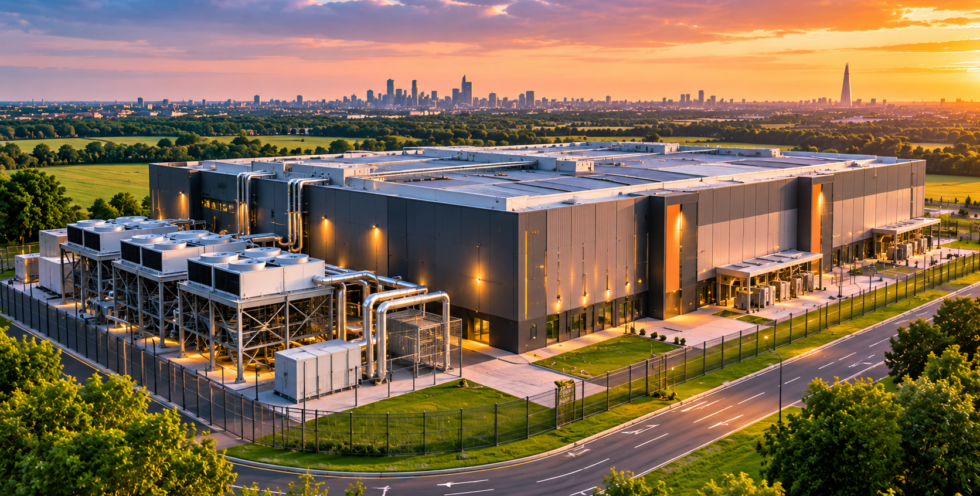
A proposed mega data centre in North Ockendon, Havering, east London, is facing strong opposition from local residents concerned about its impact on the countryside, electricity supplies, water resources and quality of life.
The development, proposed by Digital Reef, could become one of Europe’s largest data centre campuses. Developers say it would create employment opportunities, support digital infrastructure and introduce new green spaces. However, residents fear years of construction, increased traffic, noise and pressure on already stretched local utilities.
Why does the UK need more data centres?
Demand for data centres is growing rapidly as businesses increasingly rely on cloud computing, online services and artificial intelligence.
The UK currently has approximately 477 data centres, with around 100 additional facilities expected to be developed, according to the BBC’s report on UK data centre expansion.
London and the South East are expected to attract much of this growth, making suitable land, electricity capacity and water availability increasingly important considerations.
Electricity and water are major concerns
Data centres require substantial electricity to operate servers and cooling systems. A Greater London Authority report identifies electricity availability as one of the biggest obstacles to future expansion, with some new grid connections potentially taking seven to 13 years.
Water consumption is another concern. The report estimates that a 100MW hyperscale data centre could consume up to 2.5 billion litres of water annually, depending on its cooling systems.
Industry representatives argue that modern facilities are becoming more efficient through renewable electricity, closed-loop cooling and advanced technologies that reduce water consumption.
Developers promise jobs and environmental benefits
Digital Reef says more than half of its proposed site would be dedicated to a 113-hectare ecology park, including walking and cycling routes. The company also promises local employment and skills-training opportunities.
However, residents and environmental campaigners question whether these benefits would justify building such a large development on protected green belt land.
Havering Council says further consultation will take place and that it would seek to maximise environmental and economic benefits if the project progresses.
Balancing AI growth with environmental responsibility
The proposed development highlights a wider challenge facing the technology industry: AI, cloud computing and digital services need increasingly powerful infrastructure, but building that infrastructure requires land, energy and water.
The bigger picture: Data centres are becoming essential to the digital economy, but their expansion cannot come at any cost. The challenge for governments and developers is to deliver the infrastructure needed for future AI growth while protecting communities, natural resources and the environment.
Original source (Credit):
BBC News – We all need data, but do we need the largest data centre in Europe here?
This article is an independently prepared, AI-assisted summary of reporting originally published by BBC News. The original source is credited above. The content has been condensed and rewritten for informational purposes.